Mal’akh’s Thirty-third-Degree Masonic Initiation
The Lost SymbolMal’akh’s Thirty-third-Degree Masonic Initiation is both a formal passage into the highest echelon of Freemasonry and a calculated act of deception. At the Masonic House of the Temple, Mal’akh takes part in a solemn ceremony of witnesses, vows, and symbolic transformation, but he enters the brotherhood not to honor its trust: he means to use his new standing as a route toward its most closely guarded secret. The scene makes initiation a threshold with two opposed meanings—belonging for the assembled brothers, and strategic access for the man they admit.
Setting and Ritual
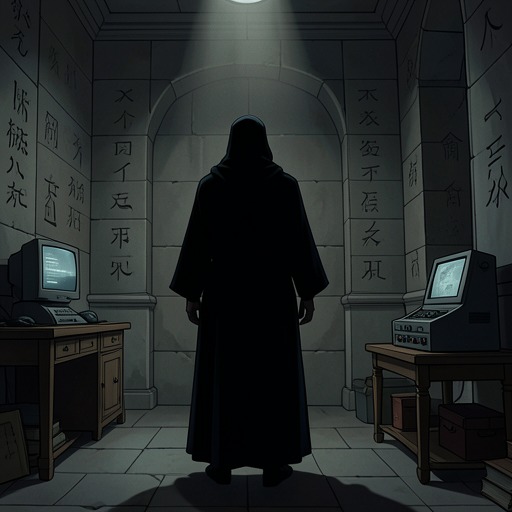
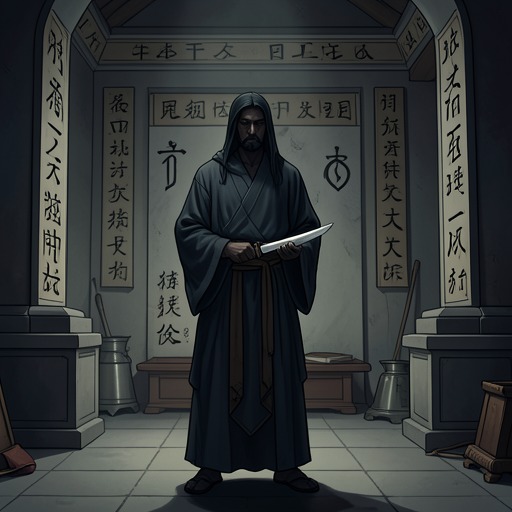
The ceremony takes place at 8:33 p.m. in the Temple Room of the Masonic House of the Temple, a Washington, D.C., building whose elaborate chambers and symbolic interior frame the rite as something set apart from ordinary life. The Temple Room is a vast square, with a high ceiling, green-granite columns, tiered walnut seating, a towering throne, and walls filled with varied ancient symbols. At its center stands a polished black-marble altar. Candles and moonlight give the gathering a deliberately ceremonial atmosphere; the room’s scale and ordered arrangement make the initiate the focus of a formal communal act.
The assembly consists of brothers in Masonic regalia, including lambskin aprons, sashes, white gloves, and ceremonial jewels. Their worldly status is set aside within the room: the ceremony presents them as equals bound by a shared fraternity. The candidate, by contrast, has already passed through earlier stages of the Masonic journey and now stands before the final step. The setting thus establishes both the appeal and the power of the institution: admission means entry into a community, but the community is structured around ranks and knowledge that are not equally available to all.
The Passage to the Final Degree
The ceremony draws on the initiate’s earlier experience of entering Freemasonry. At his first degree, he had been blindfolded and asked to declare that he was freely and voluntarily seeking admission, without unworthy motives. He answered affirmatively, though he knew he was lying. The remembered oath becomes crucial context for the later ceremony: his advancement is not simply a change in rank but the continuation of an entry secured through concealed intent.
For the final stage, the initiate kneels and holds a human skull containing wine. The skull and the vow attached to the drink make mortality part of the ritual’s symbolism. Before he drinks, the assembled brothers wait in silence as he prepares to take the oath. The ceremony requires him to bind himself to secrecy through an invocation that the wine should become deadly if he knowingly breaks his promise. Rather than exposing his purpose, the solemnity of the vow gives his deception a convincing public form: he performs the act expected of a candidate while privately treating the moment as the beginning of a different undertaking.
Mal’akh’s Hidden Purpose
The prologue withholds the initiate’s name, but later identifies the man as Mal’akh. Three weeks after attaining the thirty-third degree, he looks toward the luminous dome of the United States Capitol and thinks of an ancient secret hidden somewhere in Washington. His new rank has not revealed that knowledge to him. He understands that Masonic trust is granted through nested circles and that even a long wait might not win him the confidence of those who hold the deepest secret. The initiation has therefore served a purpose, but not the one its participants assume.
Mal’akh’s private response also reverses the ceremony’s apparent moral order. The brothers regard the oath as a binding commitment and the initiate’s admission as an act of trust. Mal’akh sees the initiation as a means to power, and anticipates that events set in motion by his admission will cost the presiding master what he holds dear. The ceremony does not itself disclose exactly how Mal’akh intends to obtain the hidden knowledge; it establishes instead that he has entered the brotherhood with a concealed agenda and does not expect its leaders to reveal their secret voluntarily.
Significance in the Story
The initiation links the novel’s recurring concerns with secrecy, hierarchy, and transformation. In a classroom discussion, Robert Langdon distinguishes a secret society from a society with secrets: Freemasonry is publicly visible, but its knowledge is protected through degrees, trust, and restricted disclosure. Mal’akh’s advancement dramatizes that distinction. He reaches the highest degree, yet rank alone does not grant him the information he seeks. His ceremony gives him proximity to the institution while leaving its central secret beyond his grasp.
The rite also creates an ironic contrast with Mal’akh’s later efforts to remake himself through bodily transformation. Here, change is conferred by a community through ritual and oath; for Mal’akh, the same passage is an instrument of private self-assertion. The scene’s solemn symbols and orderly witnesses cannot guarantee the sincerity they seem to certify. By placing a deceiver inside a brotherhood founded on guarded trust, the novel turns initiation into both a genuine threshold and a breach waiting to unfold.